In 1968, Black Americans Debated What to Call Themselves

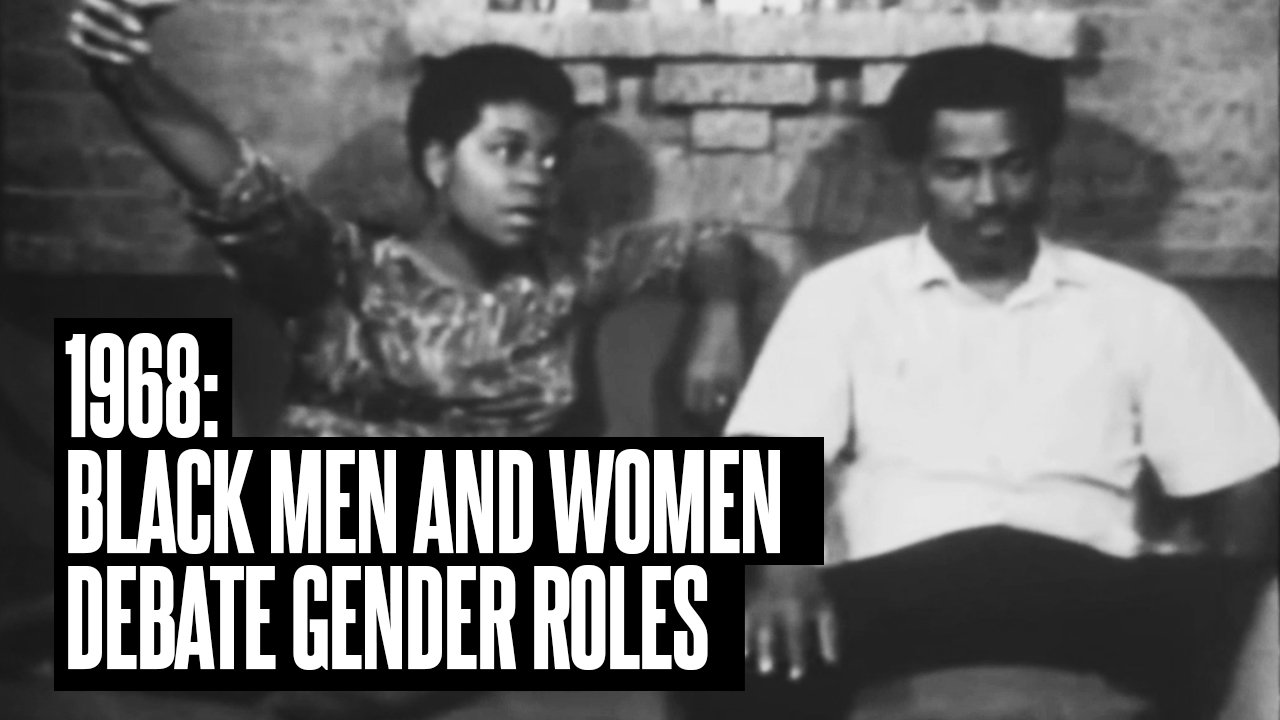
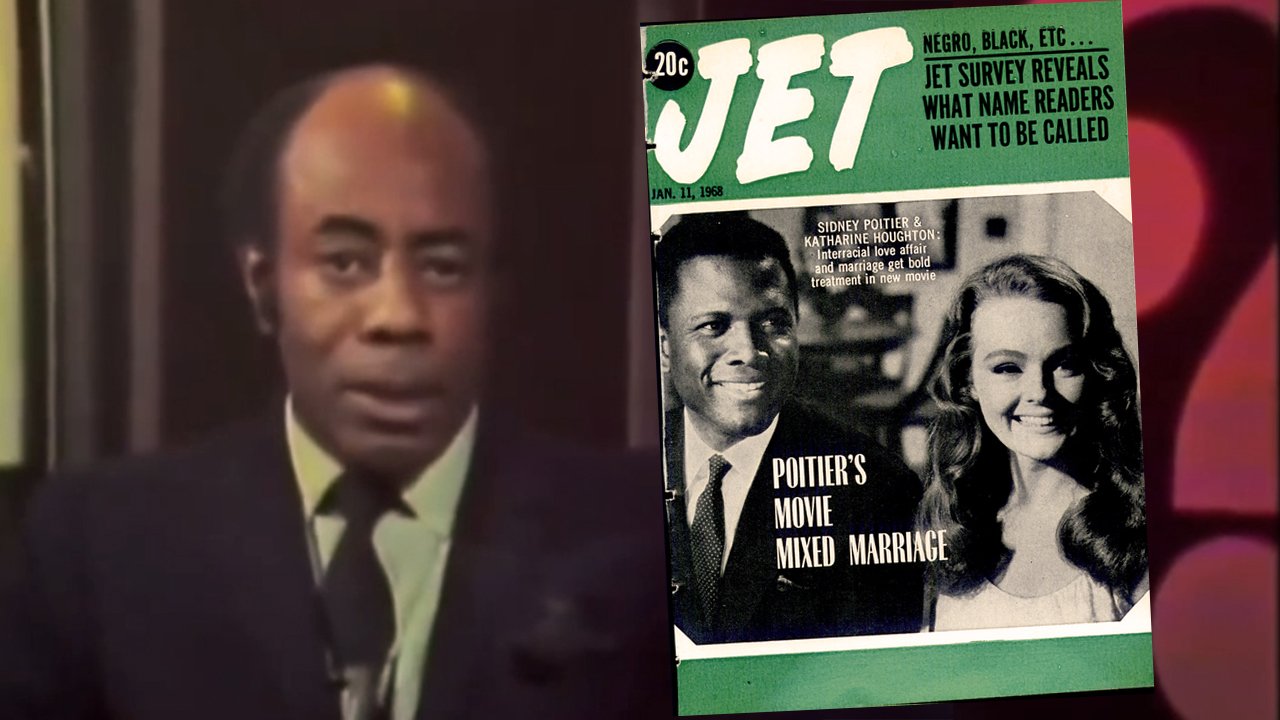
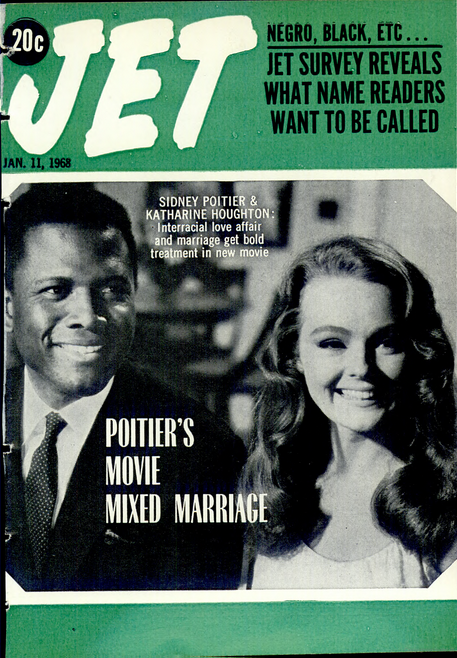
In 1968, as the country wrestled with civil rights, identity, and power, JET magazine asked a deceptively simple question: What should Black Americans be called?
The responses revealed far more than a preference for terminology. They exposed a community actively debating heritage, resistance, dignity, and self-definition in real time. Some readers chose “Afro-American” to emphasize cultural roots. Others embraced “Black” as a declaration of pride and political strength. Some defended “Negro” or “Colored,” arguing that prejudice isn’t erased by changing vocabulary.
This wasn’t just a language debate. It was a reflection of a pivotal historical moment — 1968 — when identity itself was being reshaped.
Below is the full text of the original article, preserved so you can read the words exactly as they appeared.
JET OPINION SURVEY
REVEALS WHAT NAMES THAT
By ROBERT E. JOHNSON, Jet Managing Editor
If you attend a public meeting in a black ghetto and hear the speaker begin by saying, “Master of Ceremonies, platform guests, Afro-Americans, black people, Negroes, African-Americans, colored people—and anyone else whom I unintentionally omitted,” do not feel insulted. This is just the speaker’s way of trying to identify with everyone so that he won’t have to overcome audience hostility.
To effectively inform, instruct or even entertain people who live in black ghettos, the speaker can best do it by knowing what names the people want to be called.
To determine how our readers want to be identified, JET conducted an opinion survey. The views of our readers were obtained through their written responses to questions asked at the conclusion of the article What’s In A Name? (JET, Nov. 23, 1967) by historian Lerone Bennett Jr.
In his article, Bennett, author of Black Power U.S.A., pointed out: “A large and vocal group is pressing an aggressive campaign for the use of the word ‘Afro-American’ as the only historically accurate and humanly significant designation of this large and pivotal portion of the American population.” This group, like those who want to be called “black” or “colored,” charges that the word “Negro” is “an inaccurate epithet which perpetuates the master-slave mentality in the minds of both black and white Americans.” In what author Richard B. Moore (The Name Negro: Its Origin And Evil Use) describes as “the law of association of ideas,” this pointed axiom is offered: “Give a dog a bad name and you won’t need to do the killing; just shout ‘mad dog!’ and others will kill it surely.”
On the contrary, Bennett points out that the late Dr. W. E. B. DuBois, the great Harvard-trained author-historian, argued that the term “Negro” is a fine word, better and more logical than “African,” or “colored” or any of the hyphenated variety . . . “If men despise Negroes, they will not despise them less if Negroes are called ‘Afro-Americans’ or ‘colored.’”
Compared with Bennett’s historical observations, the latest findings by JET provide a solid insight into the attitudes and opinions held by the nation’s most vocal minority racial group.
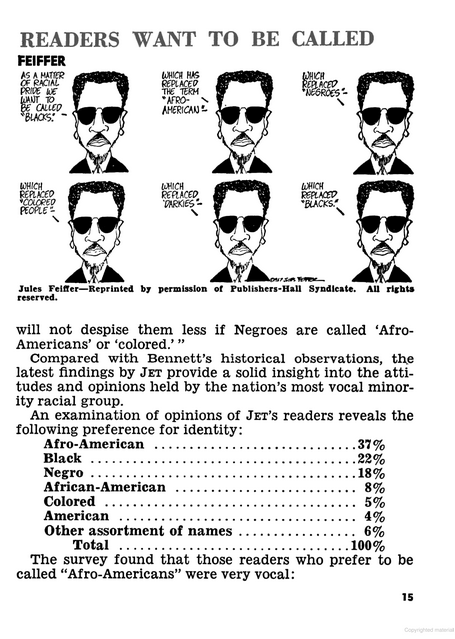
An examination of opinions of JET’s readers reveals the following preference for identity:
Afro-American ………. 37%
Black ……………… 22%
Negro ……………… 18%
African-American ……. 8%
Colored ……………. 5%
American …………… 4%
Other assortment of names .. 6%
Total ……………… 100%
The survey found that those readers who prefer to be called “Afro-Americans” were very vocal:
Most Responding Readers Prefer ‘Afro-American’
Comments 29-year-old musician Gwendolyn McKinney of Highland Park, Mich.: “Because black is only a color, Negro means black in Spanish and colored the same thing. To me there are only two cultures in this country—Euro-American and Afro-American. Color is too superficial, Afro-American has more substance, qualities, and roots and a truth.”
Said Mrs. Rose Goldsmith, a 33-year-old Jersey City, N. J., nurse: “My children and I would like to be identified as Afro-American. By the color of our skins we are known to have originated in Africa; therefore, Afro-American or African-American would be a truer name for our race of people. Wishing you success in changing dictionaries, history books, and encyclopaedias (sic).”
Sixteen-year-old Caren Cook of Denver, Colo., was brief and to the point: “I feel we should be called Afro-Americans because they call men from England ‘English-American,’ Spanish people ‘Spanish-American,’ Dutch people ‘Dutch-American.’ I think you get the picture. Negro is just another name like Mexicans for Spanish people.”
In the representative cross section of JET’s reading public, a new mood was not indigo but black:
“I have chosen Black because a Black man means not to accept the system as Negroes do, but fight hell out of it,” observes 21-year-old secretary Yvonne Williams of Chicago.
In the opinion of James Ward, a 20-year-old Mt. Vernon, N. Y., laborer, “Black would be a better name than any of the rest because it stands for one thing: Black people together as one.”
With mixed emotions, a Houston, Tex., housewife, Mrs. Ethel Wilson, told JET: “Frankly, I would like to be called ‘Black’—Black and beautiful with a kinky Afro hair style.
“With no thanks to my white foreparents I am branded with light skin and straight hair so I have no choice but to be called a Negro. I envy my black beautiful soul sisters and brothers who are now walking tall and proud, no longer ashamed of being black!”
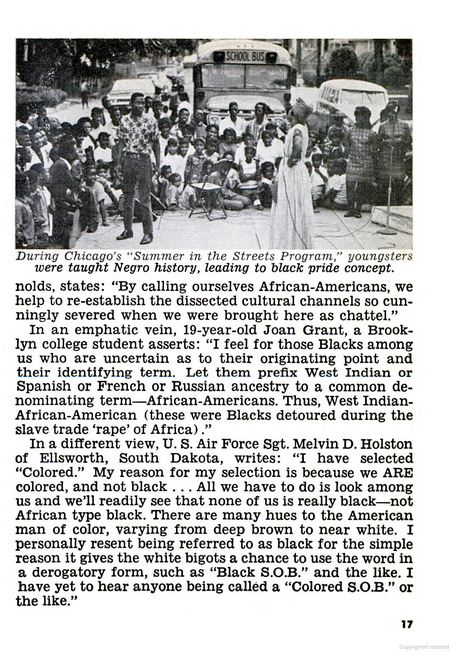
A 52-year-old Cincinnati, Ohio, laborer, Paul Reynolds, states: “By calling ourselves African-Americans, we help to re-establish the dissected cultural channels so cunningly severed when we were brought here as chattel.”
In an emphatic vein, 19-year-old Joan Grant, a Brooklyn college student asserts: “I feel for those Blacks among us who are uncertain as to their origination point and their identity for them. Let them prefix West Indian or Spanish or French or Russian ancestry to a common denominating term—African-Americans. Thus, West Indian-African-American (these were Blacks detoured during the slave trade ‘rape’ of Africa).”
In a different view, U. S. Air Force Sgt. Melvin D. Holston of Ellsworth, South Dakota, writes: “I have selected ‘Colored.’ My reason for my selection is because we ARE colored, and not black. . . . All we have to do is look among us and we’ll readily see that none of us is really black—not African type black. There are many hues to the American man of color, varying from deep brown to near white. I personally resent being referred to as black for the simple reason it gives the white bigots a chance to use the word in a derogatory form, such as ‘Black S.O.B.’ and the like. I have yet to hear anyone being called a ‘Colored S.O.B.’ or the like.”
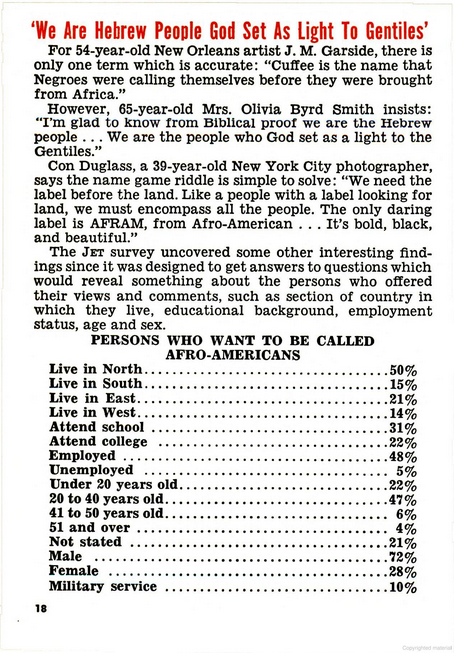
‘We Are Hebrew People God Set As Light To Gentiles’
For 54-year-old New Orleans artist J. M. Garside, there is only one term which is accurate: “Cuffee is the name that Negroes were calling themselves before they were brought from Africa.”
However, 65-year-old Mrs. Olivia Byrd Smith insists: “I’m glad to know from Biblical proof we are the Hebrew people . . . We are the people who God set as a light to the Gentiles.”
Con Duglass, a 39-year-old New York City photographer, says the name game riddle is simple to solve: “We need the label before the land. Like a people with a label looking for land, we must encompass all the people. The only daring label is AFRAM, from Afro-American . . . It’s bold, black, and beautiful.”
The JET survey uncovered some other interesting findings since it was designed to get answers to questions which would reveal something about the persons who offered their views and comments, such as section of country in which they live, educational background, employment status, age and sex.
PERSONS WHO WANT TO BE CALLED AFRO-AMERICANS
Live in North ………. 50%
Live in South ………. 15%
Live in East ……….. 21%
Live in West ……….. 14%
Attend school ………. 31%
Attend college ……… 22%
Employed …………… 48%
Unemployed …………. 5%
Under 20 years old ….. 22%
20 to 40 years old ….. 47%
41 to 50 years old ….. 6%
51 and over ………… 4%
Not stated …………. 21%
Male ………………. 72%
Female …………….. 28%
Military service ……. 10%
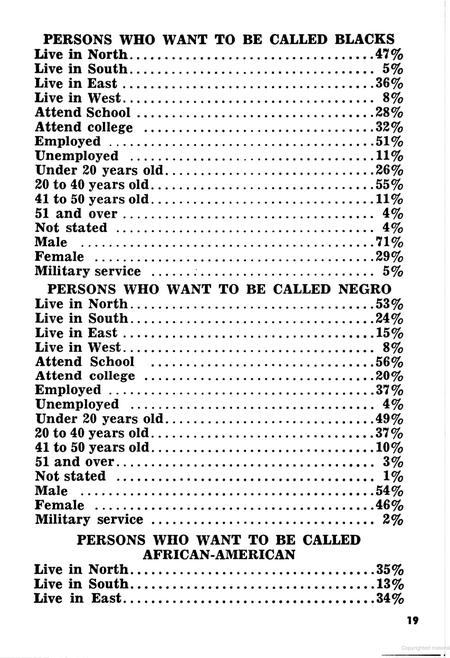
PERSONS WHO WANT TO BE CALLED BLACKS
Live in North ………. 47%
Live in South ………. 5%
Live in East ……….. 36%
Live in West ……….. 8%
Attend school ………. 28%
Attend college ……… 32%
Employed …………… 51%
Unemployed …………. 11%
Under 20 years old ….. 26%
20 to 40 years old ….. 55%
41 to 50 years old ….. 11%
51 and over ………… 4%
Not stated …………. 4%
Male ………………. 71%
Female …………….. 29%
Military service ……. 5%
PERSONS WHO WANT TO BE CALLED NEGRO
Live in North ………. 53%
Live in South ………. 24%
Live in East ……….. 15%
Live in West ……….. 8%
Attend school ………. 56%
Attend college ……… 20%
Employed …………… 37%
Unemployed …………. 4%
Under 20 years old ….. 49%
20 to 40 years old ….. 37%
41 to 50 years old ….. 10%
51 and over ………… 3%
Not stated …………. 1%
Male ………………. 54%
Female …………….. 46%
Military service ……. 2%
PERSONS WHO WANT TO BE CALLED AFRICAN-AMERICAN
Live in North ………. 35%
Live in South ………. 13%
Live in East ……….. 34%
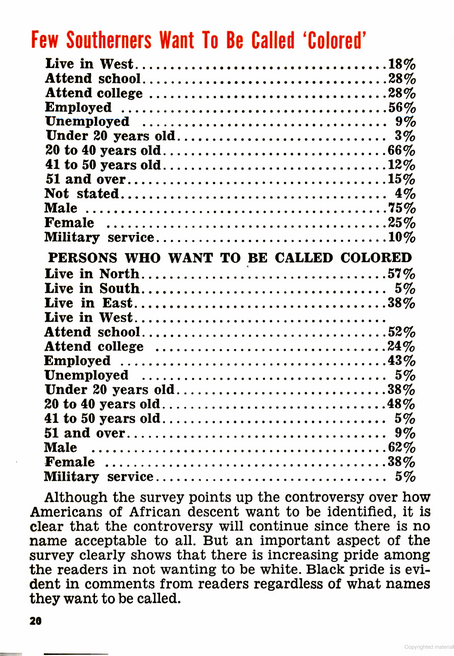
Live in West ……….. 18%
Attend school ………. 28%
Attend college ……… 28%
Employed …………… 56%
Unemployed …………. 9%
Under 20 years old ….. 3%
20 to 40 years old ….. 66%
41 to 50 years old ….. 12%
51 and over ………… 15%
Not stated …………. 4%
Male ………………. 75%
Female …………….. 25%
Military service ……. 10%
PERSONS WHO WANT TO BE CALLED COLORED
Live in North ………. 57%
Live in South ………. 5%
Live in East ……….. 38%
Live in West ……….. 0%
Attend school ………. 52%
Attend college ……… 24%
Employed …………… 43%
Unemployed …………. 5%
Under 20 years old ….. 38%
20 to 40 years old ….. 48%
41 to 50 years old ….. 5%
51 and over ………… 9%
Male ………………. 62%
Female …………….. 38%
Military service ……. 5%
Although the survey points up the controversy over how Americans of African descent want to be identified, it is clear that the controversy will continue since there is no name acceptable to all. But an important aspect of the survey clearly shows that there is increasing pride among the readers in not wanting to be white. Black pride is evident in comments from readers regardless of what names they want to be called.
Sharing